2026 U.S. & Allies–Iran Conflict Cost Monitor (MCCM): March 16
Powered by AIPAMS
1. Introduction
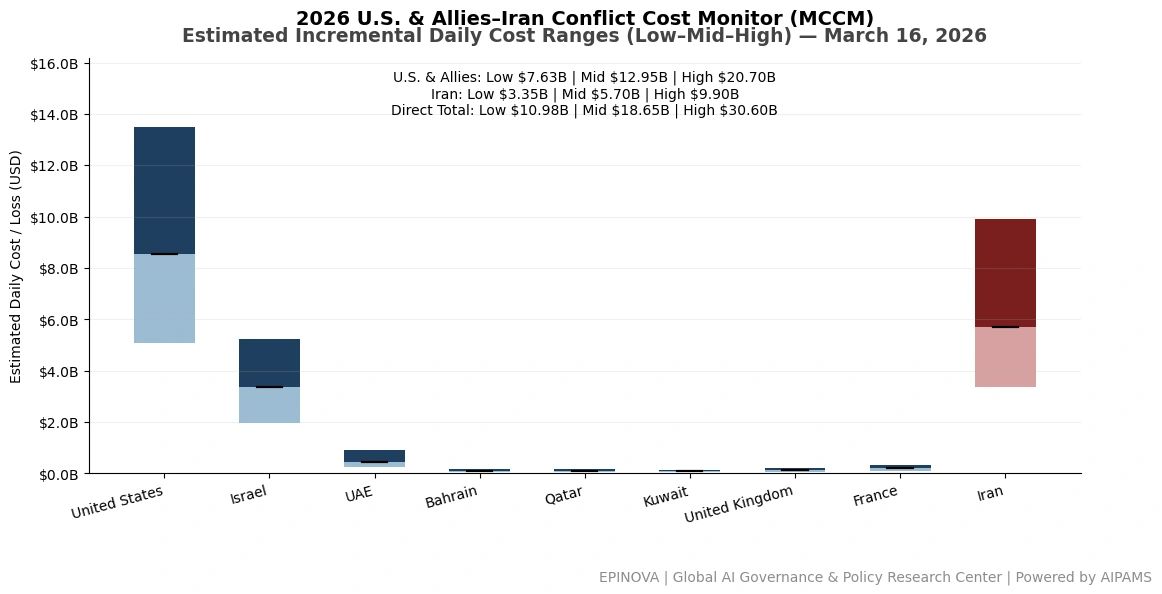
The 2026 Middle East Conflict Cost Monitor (MCCM) provides an event-driven, scenario-based assessment of daily conflict-related expenditures and losses across major state actors involved in the crisis. Using a structured low–mid–high estimation framework, the series aggregates publicly available operational indicators, force posture changes, strike intensity proxies, reported material damage, and infrastructure disruptions to produce comparable daily cost ranges.
The MCCM framework distinguishes between three analytical components:
(1) Direct War Cost, which includes military operational expenditures, asset losses, and selected capital losses (CAPEX);
(2) Infrastructure and energy-sector disruption costs linked to conflict operations; and
(3) Systemic market spillovers (“Global Shock”), which capture broader economic and logistical externalities associated with regional escalation.
Direct war costs and systemic spillovers are reported separately to maintain analytical clarity between conflict-specific expenditures and wider economic effects.
MCCM is designed as a rolling monitoring instrument rather than a definitive accounting ledger. Estimates are produced using scenario-bounded ranges intended to support comparative analysis and policy discussion rather than precise fiscal accounting. All values are expressed in current U.S. dollars (USD) and may be revised retroactively as verification improves and additional information becomes available.
.png/:/rs=w:1280)
2. Methodological Notes
A. Scenario Ranges.
All estimates are presented as bounded ranges.
- Low: Minimum confirmed observable losses.
- Mid: Most probable estimate based on publicly available reporting and operational cost parameters.
- High: Upper-bound scenario incorporating reported but not independently verified high-value asset losses.
B. Daily Estimates.
Reported figures represent incremental 24-hour estimates of conflict-related costs and losses.
C. Cumulative Totals.
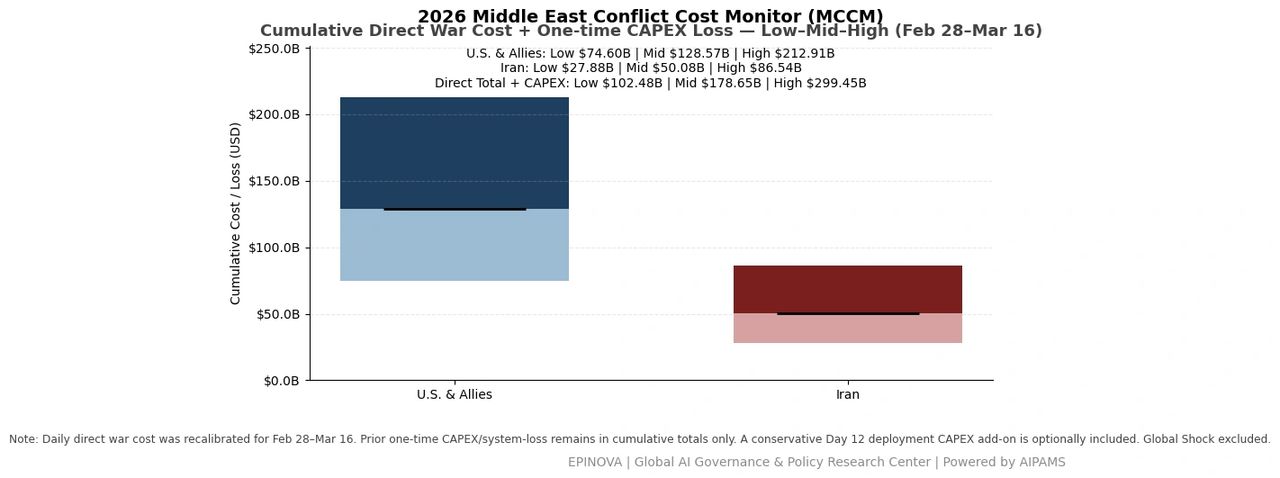
Cumulative values reflect the aggregation of daily scenario ranges over the reporting period. High-range values may include scenario-based adjustments for reported strategic asset losses pending independent verification.
D. Global Shock.
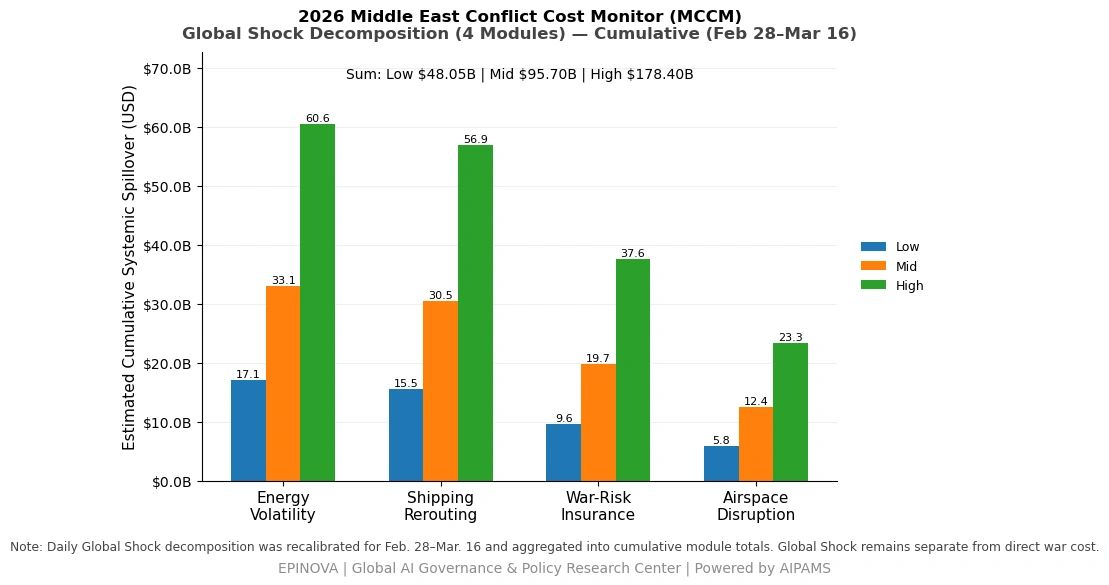
Global Shock represents systemic economic spillovers generated by the conflict and is reported separately from direct military costs. It is decomposed into four modules:
- Energy Volatility
- Shipping Rerouting
- War-Risk Insurance Premiums
- Airspace Disruption
These modules capture major economic and logistical externalities associated with regional escalation.
E. Combined Exposure (Heuristic).
In selected figures, Direct War Cost and Global Shock may be displayed together as a Combined Exposure heuristic to illustrate the approximate scale of total economic exposure associated with the conflict. This aggregation is analytical only and should not be interpreted as a formal consolidated fiscal account.
F. Revision Policy.
All MCCM estimates are derived from open-source reporting and model-based reconstruction and remain subject to revision as verification improves.
Selected References:
Reuters. (2026, March 16). Oil loading operations suspended at UAE’s Fujairah port after attack.
https://www.reuters.com/business/energy/oil-loading-operations-suspended-uaes-fujairah-port-sources-say-2026-03-16/
Reuters. (2026, March 16). UAE crude output falls by more than half as Hormuz closure forces shut-ins.
https://www.reuters.com/business/energy/uae-crude-output-falls-by-more-than-half-hormuz-closure-forces-shut-ins-2026-03-16/
Reuters. (2026, March 16). Middle East oil exports drop at least 60% as Hormuz stays mostly closed.
https://www.reuters.com/business/energy/middle-east-oil-exports-drop-least-60-hormuz-stays-mostly-closed-data-shows-2026-03-16/
Reuters. (2026, March 16). Fire breaks out near Dubai International Airport after drone attack.
https://www.reuters.com/world/middle-east/fire-breaks-out-vicinity-dubai-international-airport-after-drone-attack-dubai-2026-03-16/
Reuters. (2026, March 16). Britain working with allies on plan to reopen Strait of Hormuz, Starmer says.
https://www.reuters.com/world/britain-working-with-allies-plan-reopen-strait-hormuz-starmer-says-2026-03-16/
Reuters. (2026, March 16). India seeks Hormuz safe passage; Iran asks return of seized tankers.
https://www.reuters.com/world/india/india-seeks-hormuz-safe-passage-tehran-asks-return-seized-tankers-sources-say-2026-03-16/
Reuters. (2026, March 16). Global markets steady as oil volatility eases but Middle East tensions persist.
https://www.reuters.com/world/china/global-markets-global-markets-2026-03-16/
Reuters. (2026, March 16). Israel launches limited ground operations against Hezbollah in south Lebanon.
https://www.reuters.com/world/middle-east/israel-says-troops-launch-limited-operations-against-hezbollah-south-lebanon-2026-03-16/
Reuters. (2026, March 16). Trump warns NATO faces “very bad future” if allies fail to help in Hormuz crisis.
https://www.reuters.com/world/china/trump-warns-nato-faces-very-bad-future-if-allies-fail-help-us-iran-ft-reports-2026-03-16/
Reuters. (2026, March 16). U.S. considers coalition to secure Strait of Hormuz amid escalating conflict.
https://www.reuters.com/world/middle-east/us-considers-coalition-secure-strait-hormuz-2026-03-16/
Wall Street Journal. (2026, March 16). Hack on U.S. medical company shows reach of Iran’s cyber capabilities.
https://www.wsj.com/politics/national-security/hack-on-u-s-medical-company-shows-reach-of-irans-cyber-capabilities-85999878
Guardian. (2026, March 16). Ukraine war briefing: Zelenskyy says US still needs Ukrainian drone expertise.
https://www.theguardian.com/world/2026/mar/16/ukraine-war-briefing-zelenskyy-wants-new-system-to-control-ukraine-drone-sales
Associated Press. (2026, March 16). European allies reluctant to join US-led naval mission in Hormuz.
https://apnews.com/article/4d20e4ee0f47137d34ba0d67dd4dda6c
Axios. (2026, March 16). Trump weighs seizing Iran’s Kharg Island oil hub.
https://www.axios.com/2026/03/16/trump-kharg-island-oil-hormuz
Share this post: