2026 U.S. & Allies–Iran Conflict Cost Monitor (MCCM): March 25
Powered by AIPAMS
1. Introduction
The 2026 Middle East Conflict Cost Monitor (MCCM) provides an event-driven, scenario-based assessment of daily conflict-related expenditures and losses across major state actors involved in the crisis. Using a structured low–mid–high estimation framework, the series aggregates publicly available operational indicators, force posture changes, strike intensity proxies, reported material damage, and infrastructure disruptions to produce comparable daily cost ranges.
The MCCM framework distinguishes between three analytical components:
(1) Direct War Cost, which includes military operational expenditures, asset losses, and selected capital losses (CAPEX);
(2) Infrastructure and energy-sector disruption costs linked to conflict operations; and
(3) Systemic market spillovers (“Global Shock”), which capture broader economic and logistical externalities associated with regional escalation.
Direct war costs and systemic spillovers are reported separately to maintain analytical clarity between conflict-specific expenditures and wider economic effects.
MCCM is designed as a rolling monitoring instrument rather than a definitive accounting ledger. Estimates are produced using scenario-bounded ranges intended to support comparative analysis and policy discussion rather than precise fiscal accounting. All values are expressed in current U.S. dollars (USD) and may be revised retroactively as verification improves and additional information becomes available.
2. Methodological Notes
A. Scenario Ranges.
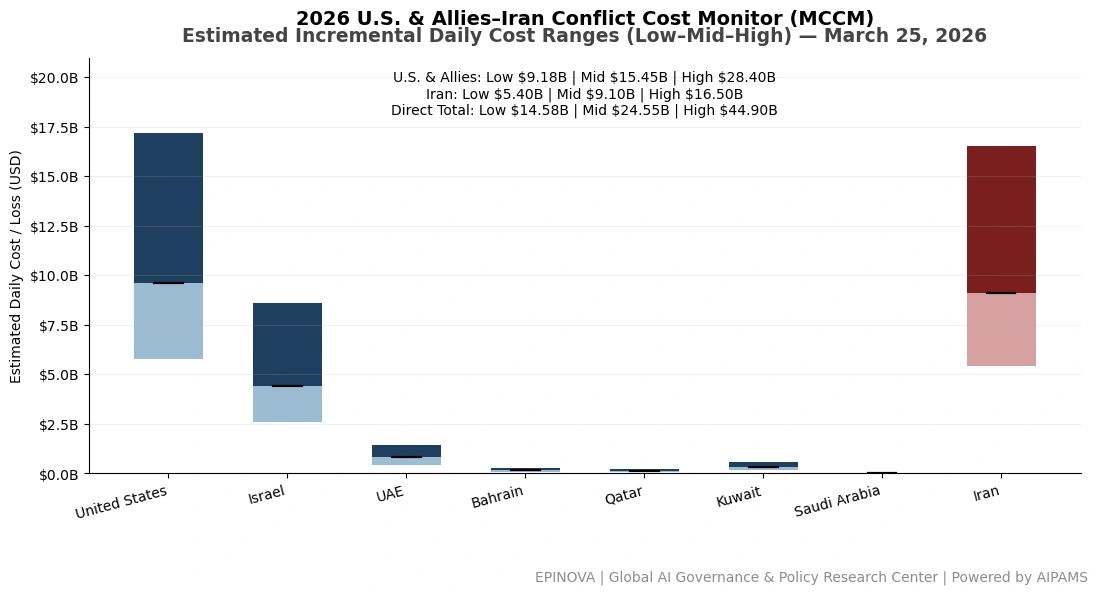
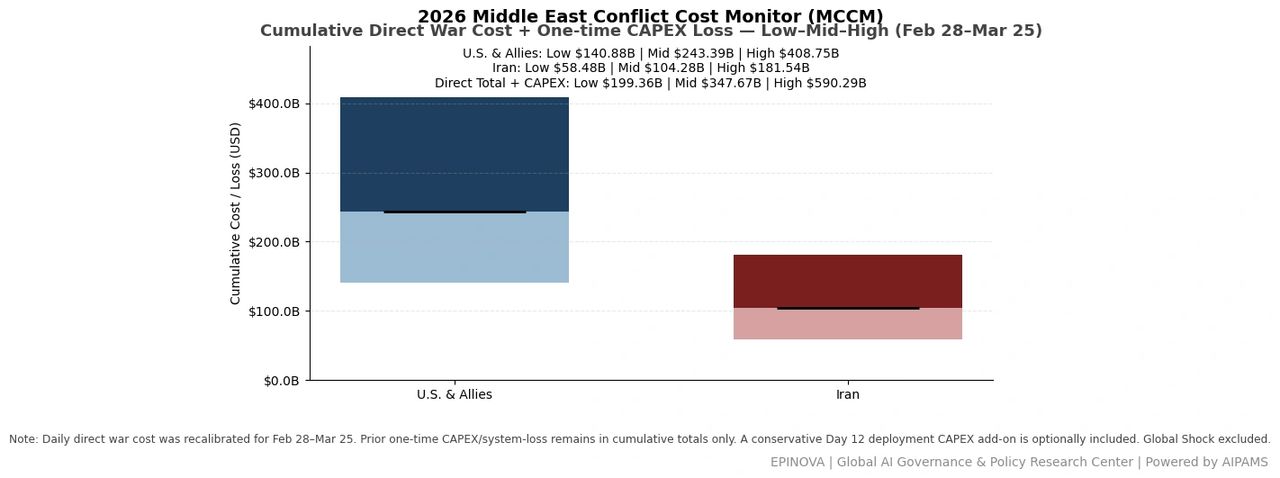
All estimates are presented as bounded ranges.
- Low: Minimum confirmed observable losses.
- Mid: Most probable estimate based on publicly available reporting and operational cost parameters.
- High: Upper-bound scenario incorporating reported but not independently verified high-value asset losses.
B. Daily Estimates.
Reported figures represent incremental 24-hour estimates of conflict-related costs and losses.
C. Cumulative Totals.
Cumulative values reflect the aggregation of daily scenario ranges over the reporting period. High-range values may include scenario-based adjustments for reported strategic asset losses pending independent verification.
D. Global Shock.
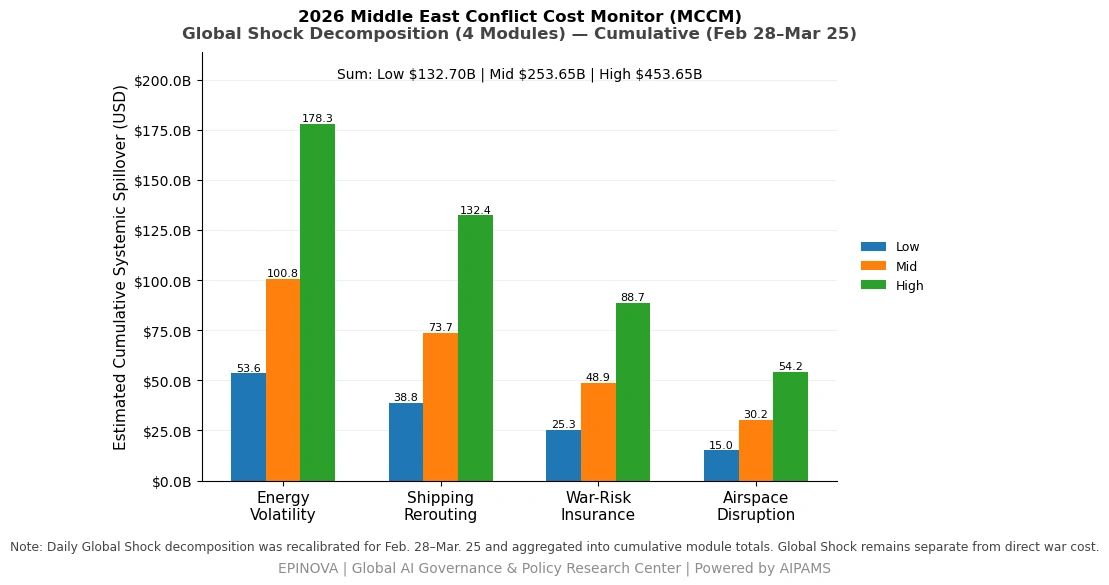
Global Shock represents systemic economic spillovers generated by the conflict and is reported separately from direct military costs. It is decomposed into four modules:
- Energy Volatility
- Shipping Rerouting
- War-Risk Insurance Premiums
- Airspace Disruption
These modules capture major economic and logistical externalities associated with regional escalation.
E. Combined Exposure (Heuristic).
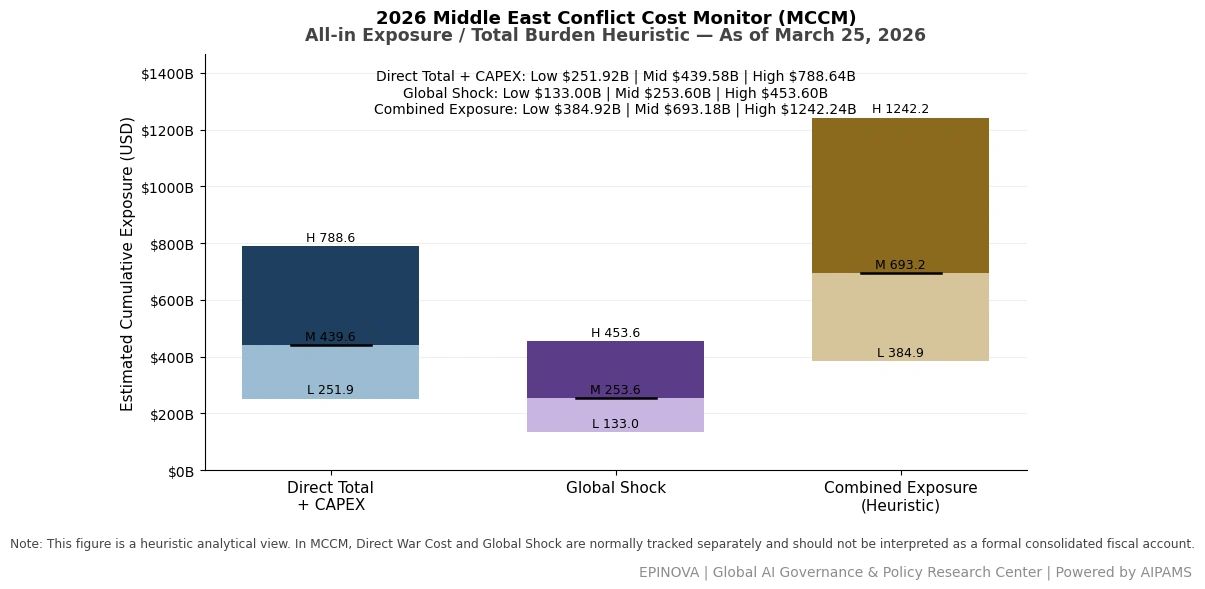
In selected figures, Direct War Cost and Global Shock may be displayed together as a Combined Exposure heuristic to illustrate the approximate scale of total economic exposure associated with the conflict. This aggregation is analytical only and should not be interpreted as a formal consolidated fiscal account.
F. Revision Policy.
All MCCM estimates are derived from open-source reporting and model-based reconstruction and remain subject to revision as verification improves.
Selected References:
Associated Press. (2026, March 24). U.S. prepares additional troop deployments to Middle East amid escalating Iran conflict. https://apnews.com/
International Atomic Energy Agency. (2026, March 24). IAEA calls for restraint after reported strikes on Iranian nuclear facilities. https://www.iaea.org/news
Reuters. (2026, March 25). Iran rejects U.S.-backed ceasefire proposal delivered via Pakistan, officials say. https://www.reuters.com/world/middle-east/
Reuters. (2026, March 25). Iran outlines conditions for ending conflict, including compensation and Strait of Hormuz sovereignty. https://www.reuters.com/world/middle-east/
Reuters. (2026, March 25). Israeli military expands reserve mobilization amid ongoing Iran-linked escalation. https://www.reuters.com/world/middle-east/
Reuters. (2026, March 25). Russia criticizes Israeli strike on Iranian Caspian port, warns of regional spillover risks. https://www.reuters.com/world/europe/
The New York Times. (2026, March 24). U.S. considers deploying additional airborne forces as Middle East conflict intensifies. https://www.nytimes.com/
The Wall Street Journal. (2026, March 25). U.S. officials say Marine expeditionary unit deploying to Central Command region. https://www.wsj.com/
U.S. Department of Defense. (2026, March 25). Force posture updates in U.S. Central Command area of responsibility. https://www.defense.gov/
U.S. Department of State. (2026, March 25). Approval of foreign military sales to Japan and South Korea. https://www.state.gov/
White House. (2026, March 24). Remarks by President Trump on U.S. operations against Iran. https://www.whitehouse.gov/
新华社. (2026年3月24日). 《国际原子能机构呼吁各方保持克制,避免伊朗核设施冲突升级》. https://www.xinhuanet.com/
新华社. (2026年3月25日). 《美方通过巴基斯坦向伊朗提出结束冲突方案》. https://www.xinhuanet.com/
新华社. (2026年3月25日). 《伊朗对美国停火提议作出回应并提出条件》. https://www.xinhuanet.com/
新华社. (2026年3月25日). 《以色列称拦截来自伊朗的导弹攻击》. https://www.xinhuanet.com/
新华社. (2026年3月25日). 《阿联酋公布防空拦截数据》. https://www.xinhuanet.com/
央视网. (2026年3月25日). 《伊朗启动新一轮导弹打击行动,持续回应冲突》. https://news.cctv.com/
Share this post: