2026 U.S. & Allies–Iran Conflict Cost Monitor (MCCM): March 26
Powered by AIPAMS (Adaptive Integrated Policy & Analytics Modeling System)
1. Introduction
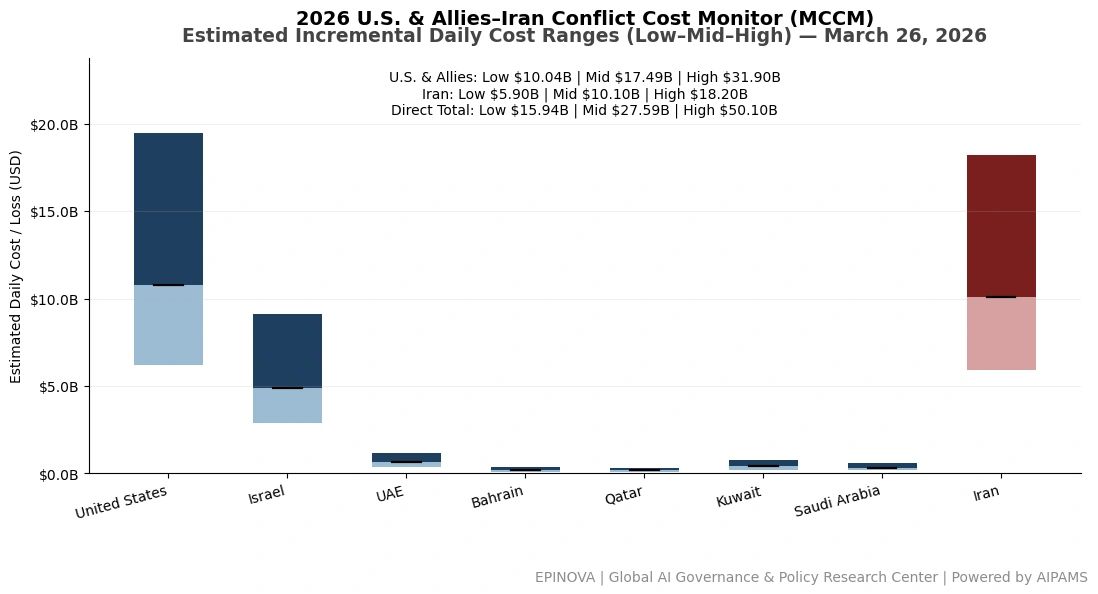
The 2026 Middle East Conflict Cost Monitor (MCCM) provides an event-driven, scenario-based assessment of daily conflict-related expenditures and losses across major state actors involved in the crisis. Using a structured low–mid–high estimation framework, the series aggregates publicly available operational indicators, force posture changes, strike intensity proxies, reported material damage, and infrastructure disruptions to produce comparable daily cost ranges.
The MCCM framework distinguishes between three analytical components:
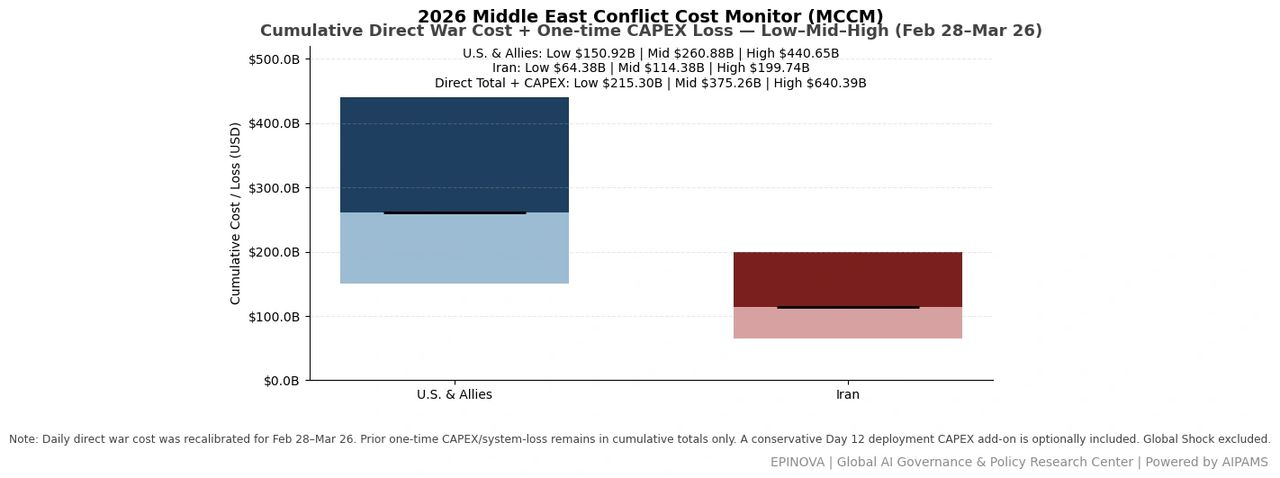
(1) Direct War Cost, which includes military operational expenditures, asset losses, and selected capital losses (CAPEX);
(2) Infrastructure and energy-sector disruption costs linked to conflict operations; and
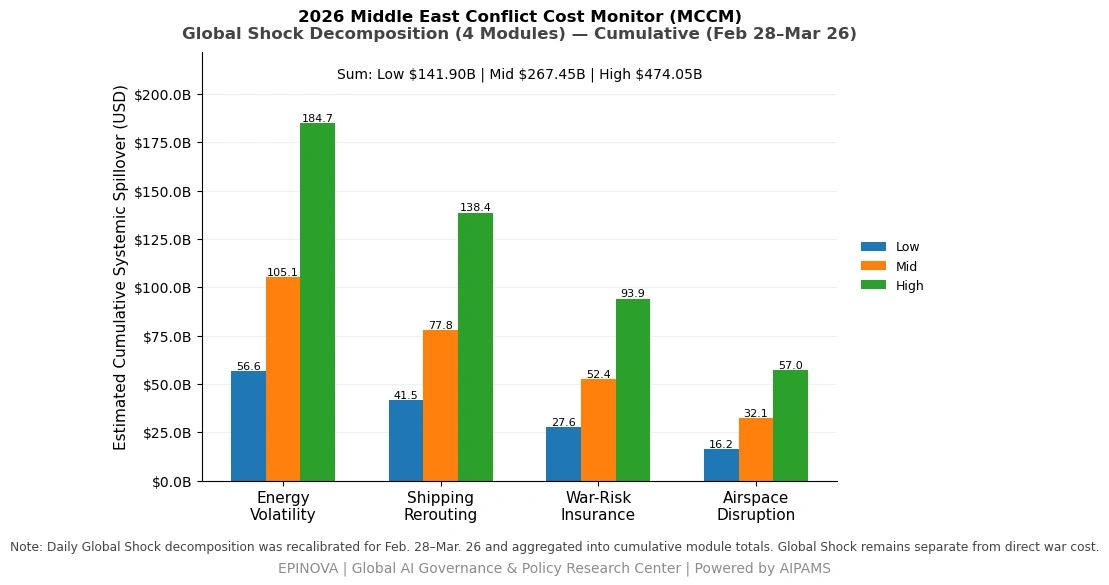
(3) Systemic market spillovers (“Global Shock”), which capture broader economic and logistical externalities associated with regional escalation.
Direct war costs and systemic spillovers are reported separately to maintain analytical clarity between conflict-specific expenditures and wider economic effects.
MCCM is designed as a rolling monitoring instrument rather than a definitive accounting ledger. Estimates are produced using scenario-bounded ranges intended to support comparative analysis and policy discussion rather than precise fiscal accounting. All values are expressed in current U.S. dollars (USD) and may be revised retroactively as verification improves and additional information becomes available.
As the conflict evolves, MCCM increasingly captures not only direct cost accumulation but also dynamic interactions between military operations, strategic signaling, and systemic economic responses, reflecting a transition from a cost-tracking model to an integrated exposure assessment framework.
2. Methodological Notes
A. Scenario Ranges.
All estimates are presented as bounded ranges.
- Low: Minimum confirmed observable losses.
- Mid: Most probable estimate based on publicly available reporting and operational cost parameters.
- High: Upper-bound scenario incorporating reported but not independently verified high-value asset losses.
B. Daily Estimates.
Reported figures represent incremental 24-hour estimates of conflict-related costs and losses.
C. Cumulative Totals.
Cumulative values reflect the aggregation of daily scenario ranges over the reporting period. High-range values may include scenario-based adjustments for reported strategic asset losses pending independent verification.
D. Global Shock.
Global Shock represents systemic economic spillovers generated by the conflict, including both escalation-driven disruptions and temporary stabilization effects arising from partial de-escalation signals (e.g., controlled energy transit, diplomatic signaling). It is decomposed into four modules:
- Energy Volatility
- Shipping Rerouting
- War-Risk Insurance Premiums
- Airspace Disruption
These modules capture major economic and logistical externalities associated with regional escalation.
D. Combined Exposure.
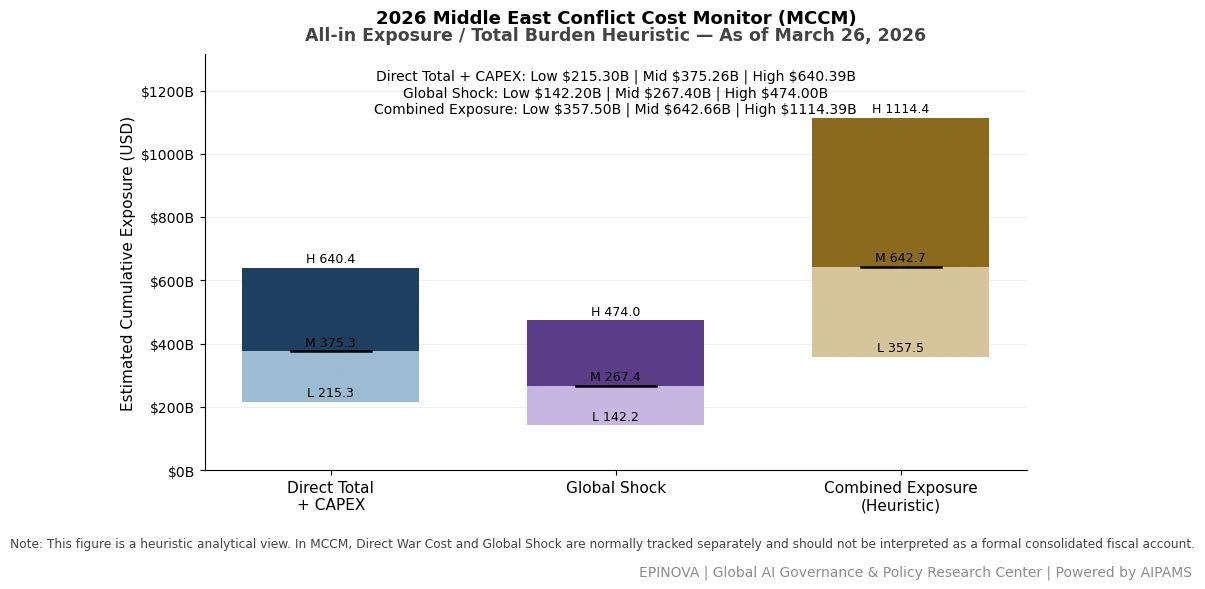
In selected figures, Direct War Cost and Global Shock may be displayed together as a Combined Exposure heuristic to illustrate the approximate scale of total economic exposure associated with the conflict. This aggregation is analytical only and should not be interpreted as a formal consolidated fiscal account. Under high-frequency strike conditions and partial system stabilization, Combined Exposure serves as a more informative indicator of systemic burden than isolated cost metrics.
E. Revision Policy.
All MCCM estimates are derived from open-source reporting and model-based reconstruction and remain subject to revision as verification improves.
F. Structural Interpretation Note.
At later stages of the conflict, cost accumulation alone may not fully capture strategic dynamics. MCCM therefore incorporates an exposure-oriented perspective, recognizing that relatively low-cost offensive actions can impose disproportionately high and persistent burdens on complex defense systems and global networks.
This asymmetry may lead to cumulative divergence in system sustainability, particularly under saturation conditions.
Selected References:
Al Jazeera. (2026, March 26). Iran launches new wave of missile strikes targeting Israeli cities and military infrastructure. https://www.aljazeera.com/news/2026/03/26/iran-launches-new-wave-of-missile-strikes
Associated Press. (2026, March 26). Iran rejects US ceasefire proposal, sets conditions for negotiations. https://apnews.com/article/iran-us-ceasefire-conditions-2026
Associated Press. (2026, March 25). Israeli military expands strikes amid concerns over potential US diplomatic shift. https://apnews.com/article/israel-strikes-iran-us-policy-2026
CNN. (2026, March 26). Iran fortifies Kharg Island as tensions escalate with US forces. https://www.cnn.com/2026/03/26/middleeast/iran-kharg-island-defense
CNN. (2026, March 25). US Central Command reports extensive strikes on Iranian military infrastructure. https://www.cnn.com/2026/03/25/politics/us-centcom-iran-strikes
Financial Times. (2026, March 26). Global oil markets stabilize after limited tanker transit through Strait of Hormuz. https://www.ft.com/content/hormuz-oil-tanker-transit-2026
Global Times. (2026, March 25). Japan to deploy troops to Philippines for joint drills in historic move. https://www.globaltimes.cn/page/202603/1287654.shtml
International Monetary Fund. (2024). World Economic Outlook database. https://www.imf.org/en/Publications/WEO/weo-database/2024
International Energy Agency. (2025). Oil market report. https://www.iea.org/reports/oil-market-report
Jane’s Defence Weekly. (2026, March 26). Iranian missile systems employed in latest strike wave: Imad, Ghadr, Khorramshahr-4 analysis. https://www.janes.com/defence-news/iran-missile-strike-analysis-2026
Lloyd’s List. (2026, March 26). War risk premiums fluctuate amid partial reopening of Hormuz shipping lanes. https://lloydslist.maritimeintelligence.informa.com/war-risk-hormuz-2026
Reuters. (2026, March 25). Iran downs US F/A-18 jet, claims IRGC; US response pending. https://www.reuters.com/world/middle-east/iran-downs-us-f18-jet-2026
Reuters. (2026, March 26). Trump says Iran allowed oil tankers through Hormuz as “gesture”. https://www.reuters.com/world/trump-iran-hormuz-tankers-2026
Reuters. (2026, March 26). Hezbollah escalates attacks on Israeli military sites amid regional tensions. https://www.reuters.com/world/middle-east/hezbollah-israel-attacks-2026
Reuters. (2026, March 26). Israel intensifies strikes on Iranian military-industrial targets under 48-hour directive. https://www.reuters.com/world/middle-east/israel-strikes-iran-escalation-2026
The New York Times. (2026, March 25). Israel accelerates air campaign as concerns grow over US ceasefire push. https://www.nytimes.com/2026/03/25/world/middleeast/israel-iran-airstrikes.html
United Nations Conference on Trade and Development. (2025). Review of Maritime Transport 2025. https://unctad.org/publication/review-maritime-transport-2025
United Nations. (2025). World Economic Situation and Prospects 2025. https://www.un.org/development/desa/dpad/publication/wesp-2025/
新华社. (2026年3月26日). 伊朗拒绝美国停战方案并提出五项条件. http://www.news.cn
新华社. (2026年3月26日). 特朗普称伊朗允许油轮通过霍尔木兹海峡作为“礼物”. http://www.news.cn
新华社. (2026年3月25日). 伊朗防空系统击落美军F-18战机. http://www.news.cn
新华社. (2026年3月26日). 黎巴嫩真主党对以色列发动多轮袭击. http://www.news.cn
央视网. (2026年3月25日). 以军称轰炸德黑兰巡航导弹生产基地. https://news.cctv.com
参考消息. (2026年3月25日). 伊拉克军事设施遭袭致人员伤亡. https://www.cankaoxiaoxi.com
Share this post: