2026 U.S. & Allies–Iran Conflict Cost Monitor (MCCM): March 28
Powered by AIPAMS (Adaptive Integrated Policy & Analytics Modeling System)
1. Introduction
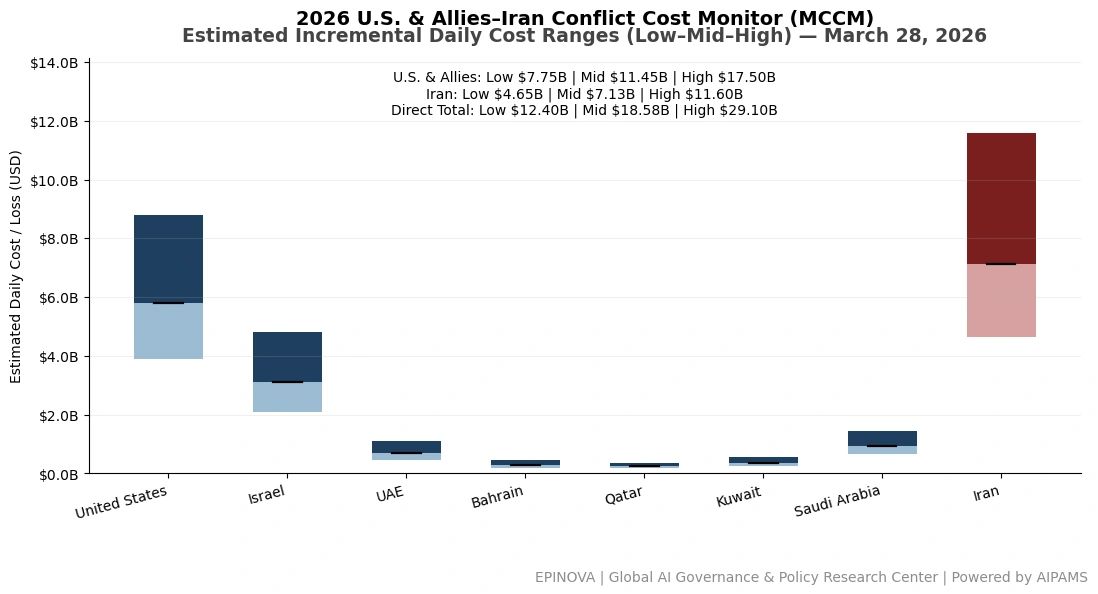
The 2026 Middle East Conflict Cost Monitor (MCCM) provides an event-driven, scenario-based assessment of daily conflict-related expenditures and losses across major state actors involved in the crisis. Using a structured low–mid–high estimation framework, the series aggregates publicly available operational indicators, force posture changes, strike intensity proxies, reported material damage, and infrastructure disruptions to produce comparable daily cost ranges.
The MCCM framework distinguishes between three analytical components:
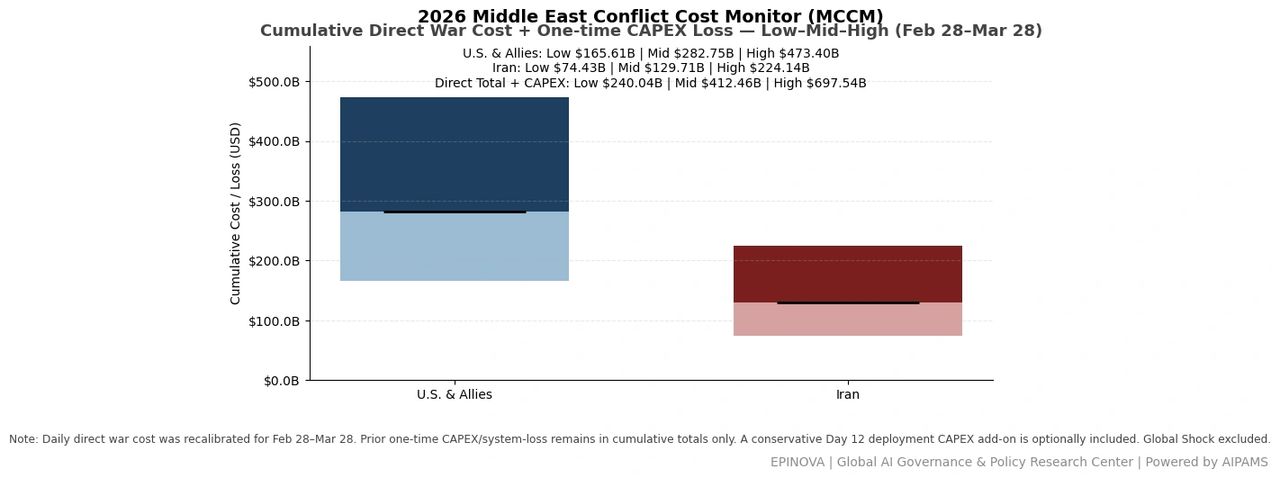
(1) Direct War Cost, which includes military operational expenditures, asset losses, and selected capital losses (CAPEX);
(2) Infrastructure and energy-sector disruption costs linked to conflict operations; and
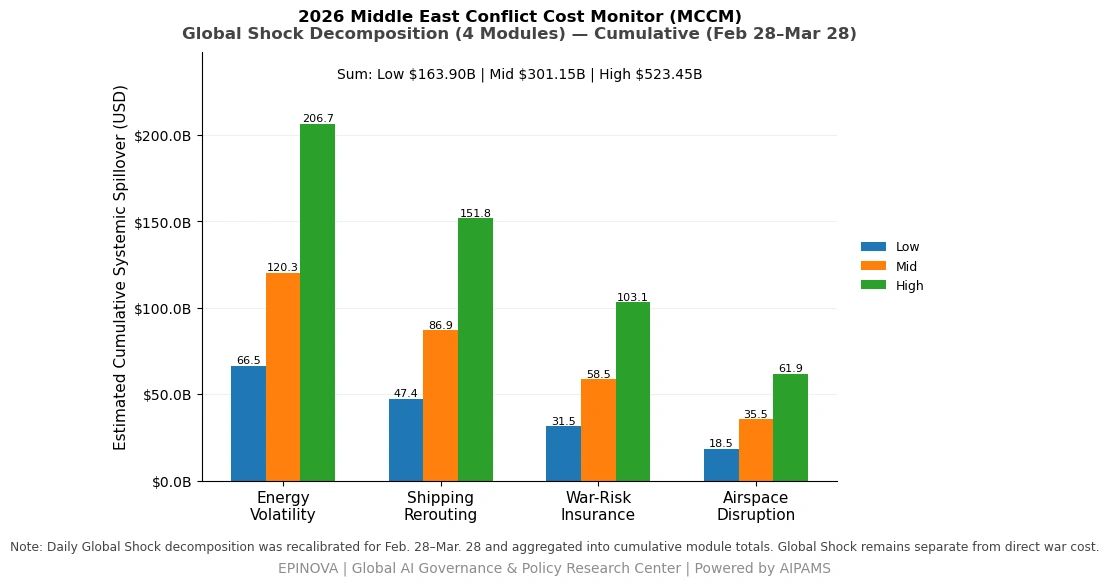
(3) Systemic market spillovers (“Global Shock”), which capture broader economic and logistical externalities associated with regional escalation.
Direct war costs and systemic spillovers are reported separately to maintain analytical clarity between conflict-specific expenditures and wider economic effects.
MCCM is designed as a rolling monitoring instrument rather than a definitive accounting ledger. Estimates are produced using scenario-bounded ranges intended to support comparative analysis and policy discussion rather than precise fiscal accounting. All values are expressed in current U.S. dollars (USD) and may be revised retroactively as verification improves and additional information becomes available.
As the conflict evolves, MCCM increasingly captures not only direct cost accumulation but also dynamic interactions between military operations, strategic signaling, and systemic economic responses, reflecting a transition from a cost-tracking model to an integrated exposure assessment framework.
.png/:/rs=w:1280)
2. Methodological Notes
A. Scenario Ranges.
All estimates are presented as bounded ranges.
- Low: Minimum confirmed observable losses.
- Mid: Most probable estimate based on publicly available reporting and operational cost parameters.
- High: Upper-bound scenario incorporating reported but not independently verified high-value asset losses.
B. Daily Estimates.
Reported figures represent incremental 24-hour estimates of conflict-related costs and losses.
C. Cumulative Totals.
Cumulative values reflect the aggregation of daily scenario ranges over the reporting period. High-range values may include scenario-based adjustments for reported strategic asset losses pending independent verification.
D. Global Shock.
Global Shock represents systemic economic spillovers generated by the conflict, including both escalation-driven disruptions and temporary stabilization effects arising from partial de-escalation signals (e.g., controlled energy transit, diplomatic signaling). It is decomposed into four modules:
- Energy Volatility
- Shipping Rerouting
- War-Risk Insurance Premiums
- Airspace Disruption
These modules capture major economic and logistical externalities associated with regional escalation.
E. Combined Exposure.
In selected figures, Direct War Cost and Global Shock may be displayed together as a Combined Exposure heuristic to illustrate the approximate scale of total economic exposure associated with the conflict. This aggregation is analytical only and should not be interpreted as a formal consolidated fiscal account. Under high-frequency strike conditions and partial system stabilization, Combined Exposure serves as a more informative indicator of systemic burden than isolated cost metrics.
F. Revision Policy.
All MCCM estimates are derived from open-source reporting and model-based reconstruction and remain subject to revision as verification improves.
G. Structural Interpretation Note.
At later stages of the conflict, cost accumulation alone may not fully capture strategic dynamics. MCCM therefore incorporates an exposure-oriented perspective, recognizing that relatively low-cost offensive actions can impose disproportionately high and persistent burdens on complex defense systems and global networks.
This asymmetry may lead to cumulative divergence in system sustainability, particularly under saturation conditions.
Selected References:
Associated Press. (2026, March 27). Iranian attack on Saudi base wounds at least 10 US troops and damages several planes. https://apnews.com/article/8404fd9b67b76c756e543fc307565572
Associated Press. (2026, March 27). Iran starts to formalize its chokehold on the Strait of Hormuz with a “toll booth” regime. https://apnews.com/article/de5159966cde7de7b964b3c2c67eec07
Associated Press. (2026, March 28). A Houthi missile attack on Israel stokes fears of renewed Red Sea shipping strikes. https://apnews.com/article/dba2e2e2309f08547a3cbfdc2c367897
International Atomic Energy Agency. (2026, March 2). IAEA Director General’s introductory statement to the special session of the Board of Governors. https://www.iaea.org/newscenter/statements/iaea-director-generals-introductory-statement-to-the-special-session-of-the-board-of-governors
International Atomic Energy Agency. (2026, March 2). IAEA Director General’s introductory statement to the Board of Governors, 2–6 March 2026. https://www.iaea.org/newscenter/statements/iaea-director-generals-introductory-statement-to-the-board-of-governors-2-6-march-2026
Israel Defense Forces. (2026, March 28). Iran–Israel War 2026 live updates (official updates page). https://www.idf.il/en/mini-sites/iran-israel-war-2026/iran-israel-war-2026-live-updates-1/march-28-2026-iran-israel-war-2026-live-updates/
Israel Defense Forces. (n.d.). IDF press releases: Israel at war. https://www.idf.il/en/mini-sites/idf-press-releases-israel-at-war/
Reuters. (2026, March 24). Iran tells UN: “non-hostile” ships can transit Strait of Hormuz. https://www.reuters.com/world/middle-east/iran-says-non-hostile-ships-can-transit-strait-hormuz-ft-reports-2026-03-24/
Reuters. (2026, March 25). Iraq oil output further plunges as storage fills, Hormuz exports blocked by conflict. https://www.reuters.com/business/energy/iraq-oil-output-further-plunges-storage-fills-hormuz-exports-blocked-by-conflict-2026-03-25/
Reuters. (2026, March 26). Iran allowing Malaysian vessels pass strait, PM says after talks with regional leaders. https://www.reuters.com/world/asia-pacific/iran-allowing-malaysian-vessels-pass-strait-pm-says-after-talks-with-regional-2026-03-26/
Reuters. (2026, March 27). German Chancellor Merz says he has doubts over Iran war aims. https://www.reuters.com/world/europe/german-chancellor-merz-says-he-has-doubts-over-iran-war-aims-2026-03-27/
Reuters. (2026, March 27). Twelve US troops wounded in Iran strike on base in Saudi Arabia, US official says. https://www.reuters.com/world/middle-east/twelve-us-troops-wounded-iran-strike-base-saudi-arabia-us-official-says-2026-03-27/
Reuters. (2026, March 28). Maersk halts operations at Oman’s Salalah port due to security incident. https://www.reuters.com/world/middle-east/maersk-halts-operations-omans-salalah-port-due-security-incident-2026-03-28/
Reuters. (2026, March 28). Two India-bound LPG tankers crossing Strait of Hormuz out of Gulf, data shows. https://www.reuters.com/business/energy/two-india-bound-lpg-tankers-crossing-strait-hormuz-out-gulf-data-shows-2026-03-28/
The Wall Street Journal. (2026, March 27). Rubio tells G7 counterparts that war will go on for 2 to 4 weeks. https://www.wsj.com/livecoverage/iran-war-middle-east-news-updates/card/rubio-tells-g7-counterparts-that-war-will-go-on-for-2-4-weeks-0vqEcx7aafABeaVTsm3I
The Wall Street Journal. (2026, March 27). Thailand says Iran agrees to let its tankers transit Strait of Hormuz. https://www.wsj.com/livecoverage/iran-war-middle-east-news-updates/card/thailand-says-iran-agrees-to-let-its-tankers-transit-strait-of-hormuz-JYAGIUa0ucCxBaHnNdFf
Washington Post. (2026, March 27). At least 10 U.S. troops wounded in Iranian attack on Saudi air base. https://www.washingtonpost.com/national-security/2026/03/27/iran-wounds-us-troops-saudi-base/
Share this post: