2026 U.S. & Allies–Iran Conflict Cost Monitor (MCCM): March 30
Powered by AIPAMS (Adaptive Integrated Policy & Analytics Modeling System)
1. Introduction
The 2026 Middle East Conflict Cost Monitor (MCCM) provides an event-driven, scenario-based assessment of daily conflict-related expenditures and losses across major state actors involved in the crisis. Using a structured low–mid–high estimation framework, the series aggregates publicly available operational indicators, force posture changes, strike intensity proxies, reported material damage, and infrastructure disruptions to produce comparable daily cost ranges.
The MCCM framework distinguishes between three analytical components:
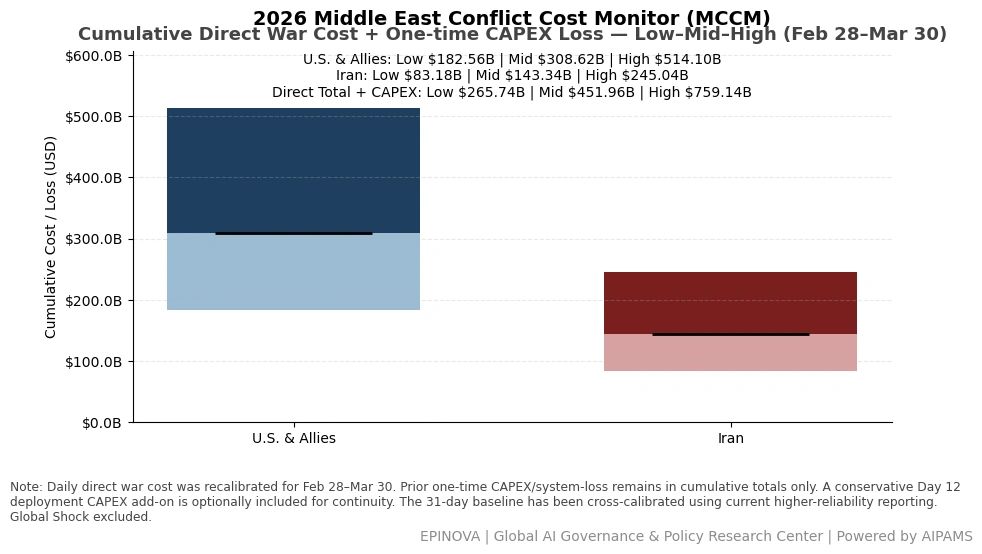
(1) Direct War Cost, which includes military operational expenditures, asset losses, and selected capital losses (CAPEX);
(2) Infrastructure and energy-sector disruption costs linked to conflict operations; and
(3) Systemic market spillovers (“Global Shock”), which capture broader economic and logistical externalities associated with regional escalation.
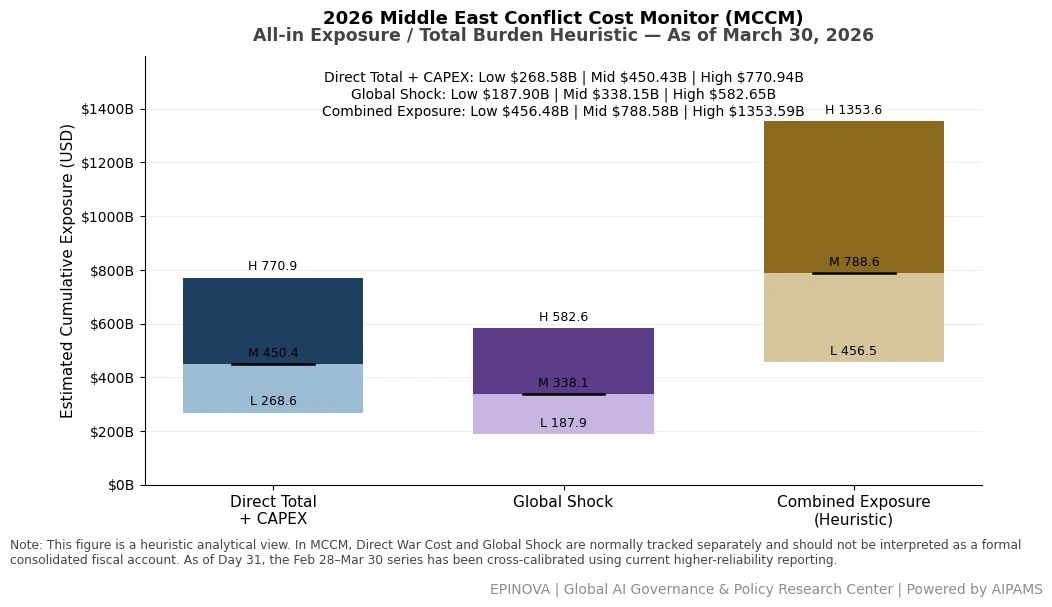
Direct war costs and systemic spillovers are reported separately to maintain analytical clarity between conflict-specific expenditures and wider economic effects.
MCCM is designed as a rolling monitoring instrument rather than a definitive accounting ledger. Estimates are produced using scenario-bounded ranges intended to support comparative analysis and policy discussion rather than precise fiscal accounting. All values are expressed in current U.S. dollars (USD) and may be revised retroactively as verification improves and additional information becomes available.
As the conflict evolves, MCCM increasingly captures not only direct cost accumulation but also dynamic interactions between military operations, strategic signaling, and systemic economic responses, reflecting a transition from a cost-tracking model to an integrated exposure assessment framework.
2. Methodological Notes
A. Scenario Ranges.
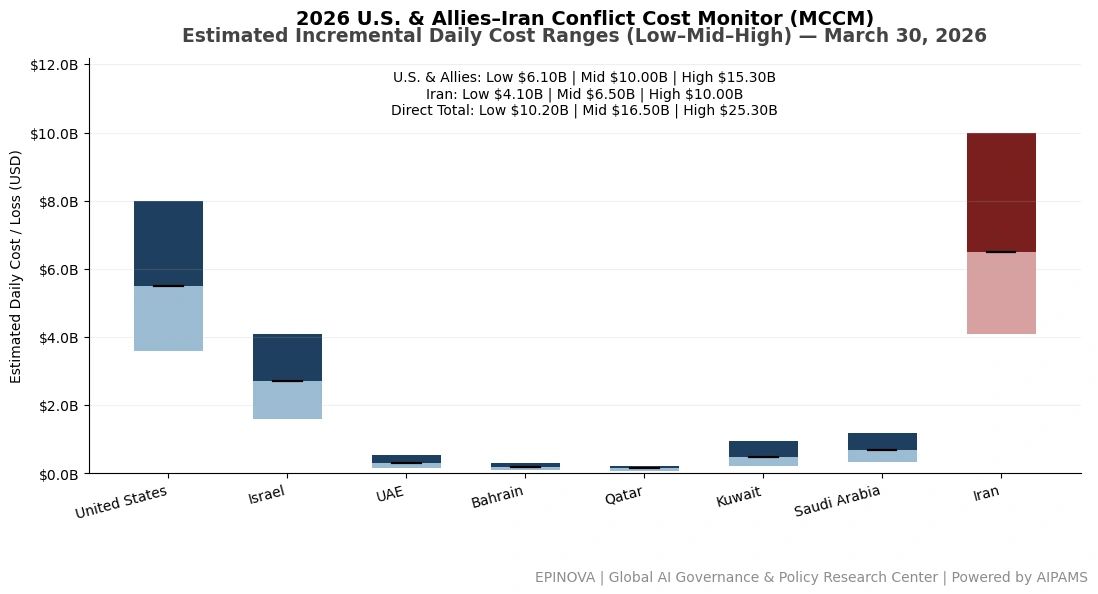
All estimates are presented as bounded ranges.
- Low: Minimum confirmed observable losses.
- Mid: Most probable estimate based on publicly available reporting and operational cost parameters.
- High: Upper-bound scenario incorporating reported but not independently verified high-value asset losses.
B. Daily Estimates.
Reported figures represent incremental 24-hour estimates of conflict-related costs and losses.
C. Cumulative Totals.
Cumulative values reflect the aggregation of daily scenario ranges over the reporting period. High-range values may include scenario-based adjustments for reported strategic asset losses pending independent verification.
D. Global Shock.
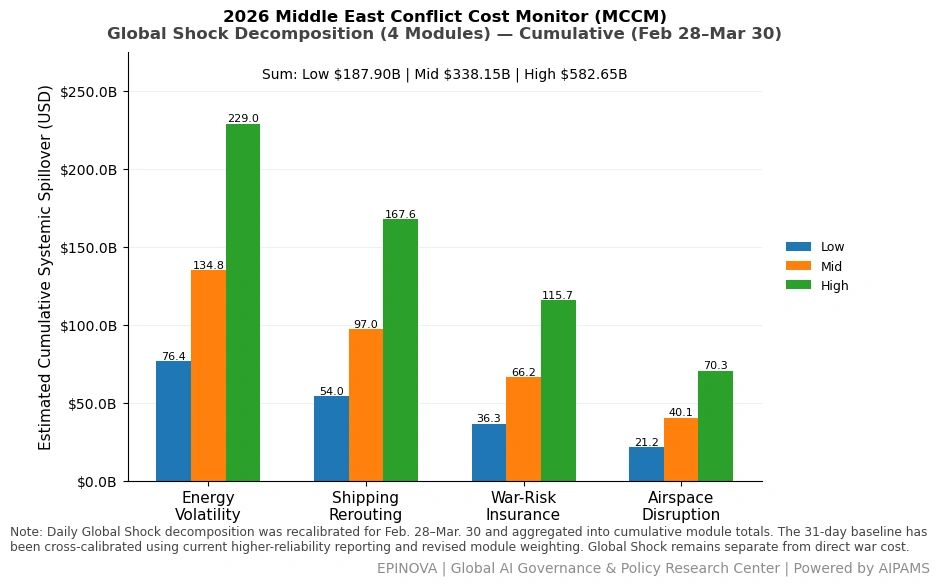
Global Shock represents systemic economic spillovers generated by the conflict, including both escalation-driven disruptions and temporary stabilization effects arising from partial de-escalation signals (e.g., controlled energy transit, diplomatic signaling). It is decomposed into four modules:
- Energy Volatility
- Shipping Rerouting
- War-Risk Insurance Premiums
- Airspace Disruption
These modules capture major economic and logistical externalities associated with regional escalation.
E. Combined Exposure.
In selected figures, Direct War Cost and Global Shock may be displayed together as a Combined Exposure heuristic to illustrate the approximate scale of total economic exposure associated with the conflict. This aggregation is analytical only and should not be interpreted as a formal consolidated fiscal account. Under high-frequency strike conditions and partial system stabilization, Combined Exposure serves as a more informative indicator of systemic burden than isolated cost metrics.
F. Revision Policy.
All MCCM estimates are derived from open-source reporting and model-based reconstruction and remain subject to revision as verification improves.
G. Structural Interpretation Note.
At later stages of the conflict, cost accumulation alone may not fully capture strategic dynamics. MCCM therefore incorporates an exposure-oriented perspective, recognizing that relatively low-cost offensive actions can impose disproportionately high and persistent burdens on complex defense systems and global networks.
This asymmetry may lead to cumulative divergence in system sustainability, particularly under saturation conditions.
Selected References:
AP News. (2026, March 30). Israeli parliament passes budget, allowing Netanyahu to avoid early elections. https://apnews.com/article/bc75b11a9d1d833733c6f9e56a15aeda
AP News. (2026, March 30). The latest: Trump warns Iran energy sites face destruction without a quick deal. https://apnews.com/article/4820feefe878b183f12eaaabc376e6b0
Associated Press. (2026, March 30). Israeli parliament approves the death penalty for Palestinians convicted of murdering Israelis. https://apnews.com/article/c67c1c14f218a4d67ed3d5011cd5cf8d
International Atomic Energy Agency. (2025, June 20). IAEA Director General Grossi’s statement to UNSC on situation in Iran. https://www.iaea.org/newscenter/statements/iaea-director-general-grossis-statement-to-unsc-on-situation-in-iran-20-june-2025
International Atomic Energy Agency. (2026, February 27). NPT safeguards agreement with the Islamic Republic of Iran (GOV/2026/8). https://www.iaea.org/sites/default/files/gov2026-8.pdf
Reuters. (2026, March 24). Iran toughens negotiating stance amid mediation efforts, sources say. https://www.reuters.com/world/middle-east/iran-toughens-negotiating-stance-amid-mediation-efforts-sources-say-2026-03-24/
Reuters. (2026, March 25). Iran says it is reviewing U.S. proposal to end war. https://www.reuters.com/world/asia-pacific/israel-strikes-tehran-trump-says-us-negotiating-end-war-2026-03-25/
Reuters. (2026, March 26). Trump pauses attacks on Iran’s energy plants, says talks “going well”. https://www.reuters.com/world/asia-pacific/iran-says-it-is-reviewing-us-ceasefire-plan-no-talks-trump-says-tehran-leaders-2026-03-26/
Reuters. (2026, March 26). U.S. proposal to end war is “one-sided”, door to diplomacy still open, Iranian official says. https://www.reuters.com/world/middle-east/us-proposal-end-war-is-one-sided-door-diplomacy-still-open-iranian-official-says-2026-03-26/
Reuters. (2026, March 29). Israeli parliament approves 2026 state budget, spokesperson says. https://www.reuters.com/world/middle-east/israeli-parliament-approves-2026-state-budget-spokesperson-says-2026-03-29/
Reuters. (2026, March 30). Brent crude hits $116 a barrel as Trump threatens to “blow up” Iran’s oil wells and export hub. The Guardian. https://www.theguardian.com/business/2026/mar/30/price-of-oil-trump-iran-stock-markets-middle-east
Reuters. (2026, March 30). Chinese container ships pass through Strait of Hormuz at second attempt, data shows. https://www.reuters.com/world/china/chinese-container-ships-pass-through-strait-hormuz-second-attempt-data-shows-2026-03-30/
Reuters. (2026, March 30). EU’s Costa discusses Iran situation with Pakistan’s prime minister. https://www.reuters.com/world/asia-pacific/eus-costa-discusses-iran-situation-with-pakistans-prime-minister-2026-03-30/
Reuters. (2026, March 30). Indian worker killed in Iranian attack on Kuwait power, desalination plant. https://www.reuters.com/world/india/indian-worker-killed-iranian-attack-kuwait-power-desalination-plant-2026-03-29/
Reuters. (2026, March 30). Israel economy to grow 3.3% in 2026 if Iran war continues, finance ministry says. https://www.reuters.com/world/middle-east/israel-economy-grow-33-2026-if-iran-war-continues-finance-ministry-says-2026-03-30/
Reuters. (2026, March 30). Pakistan, Afghanistan trade fire as Islamabad prepares to host U.S.-Iran talks. https://www.reuters.com/world/asia-pacific/pakistan-afghanistan-trade-fire-islamabad-prepares-host-us-iran-talks-2026-03-30/
Reuters. (2026, March 30). Thousands of U.S. Army paratroopers arrive in Middle East as buildup intensifies. https://www.reuters.com/world/middle-east/thousands-us-army-paratroopers-arrive-middle-east-buildup-intensifies-2026-03-30/
Reuters. (2026, March 30). Trump again warns Iran to open Strait of Hormuz. https://www.reuters.com/world/middle-east/trump-again-warns-iran-open-strait-hormuz-2026-03-30/
Reuters. (2026, March 30). Trump issues new warning to Tehran, Iran calls U.S. peace proposals “unrealistic”. https://www.reuters.com/world/asia-pacific/trump-calls-irans-current-leaders-very-reasonable-pakistan-prepares-host-talks-2026-03-30/
The Guardian. (2026, March 29). Iran accuses U.S. of plotting ground assault while publicly seeking talks. https://www.theguardian.com/world/2026/mar/29/iran-accuses-us-plotting-ground-assault-publicly-seeking-talks
The Guardian. (2026, March 30). Trump threatens to “obliterate” Iran’s energy grid if ceasefire not reached shortly. https://www.theguardian.com/us-news/2026/mar/30/trump-threatens-to-obliterate-irans-energy-grid-if-ceasefire-not-reached-shortly
The Times. (2026, March 30). Iran war latest: Trump threatens obliteration of Kharg Island if no deal made. https://www.thetimes.com/world/middle-east/israel-iran/article/iran-war-trump-oil-latest-news-dgx330xvf
The Wall Street Journal. (2026, March 30). Iranian-linked groups hacked into at least 50 security cameras in Israel. https://www.wsj.com/livecoverage/iran-war-news-updates/card/iranian-linked-groups-hacked-into-at-least-50-security-cameras-in-israel-dwrn3Wa3KcI3NfbGiHJl
The Wall Street Journal. (2026, March 30). Struck Khondab heavy-water plant no longer operational, U.N. agency says. https://www.wsj.com/livecoverage/iran-war-middle-east-news-updates/card/struck-khondab-heavy-water-plant-no-longer-operational-u-n-agency-HPSfsWdzKYus6HgIPNCD
The Washington Post. (2026, March 25). U.S. plan to end war seeks removal of Iran’s enriched uranium, officials say. https://www.washingtonpost.com/world/2026/03/25/us-iran-war-trump-talks-pakistan/
Share this post: